In the context of my work, the most immediate meaning of the word “dependency” is a data dependency. People like to make graphs to show these:
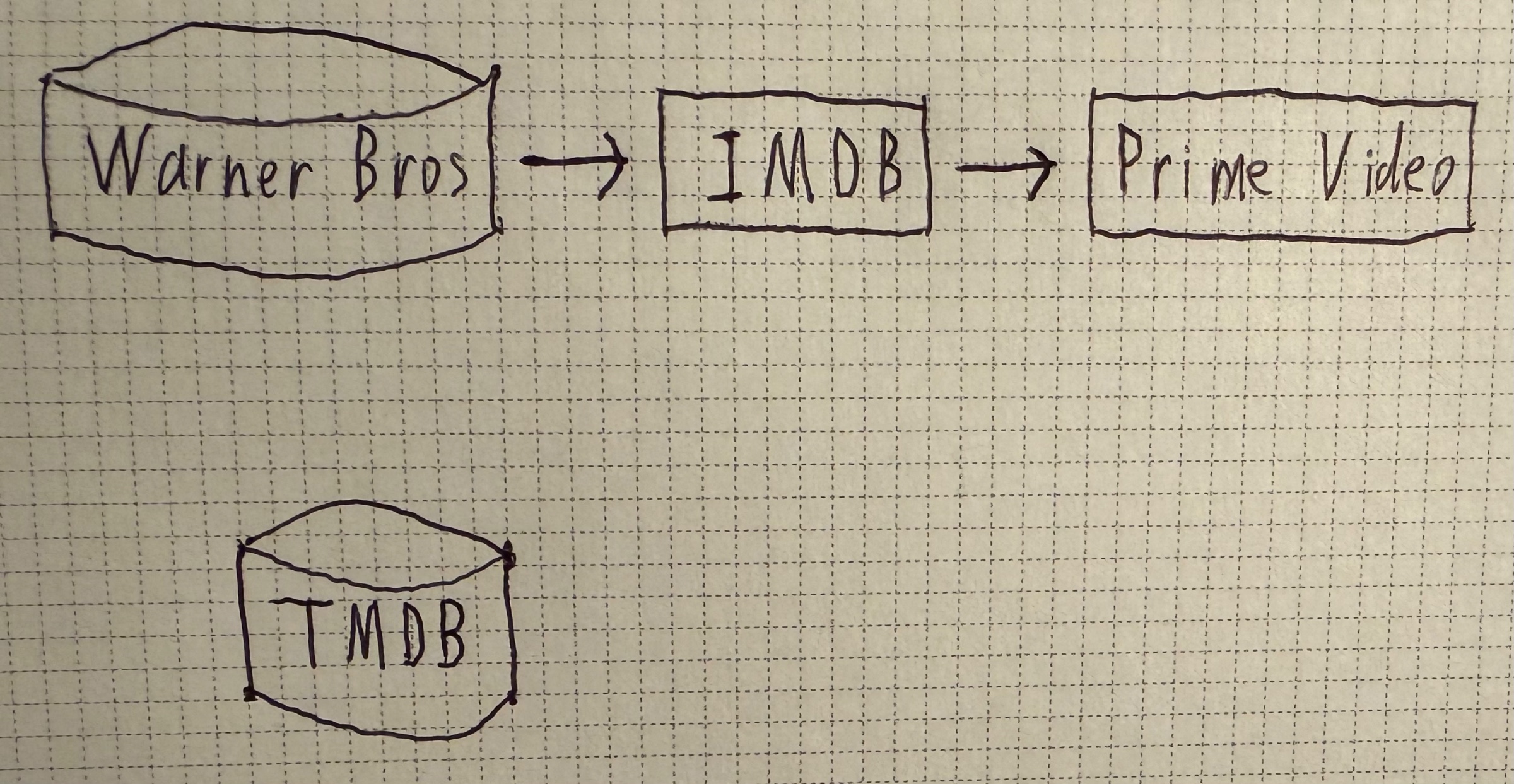
This one is showing you how “movie metadata” flows. Not the actual movie you watch, the other stuff: titles, years, actors, just various facts about the movie. IMDB, in my simplified diagram, are getting that straight from the producers. Then Amazon Prime Video is getting that from IMDB.
Now, pretend you are about to make something that might like this same data. Maybe it’s called Jellyfin. Where would you choose to get the data from?
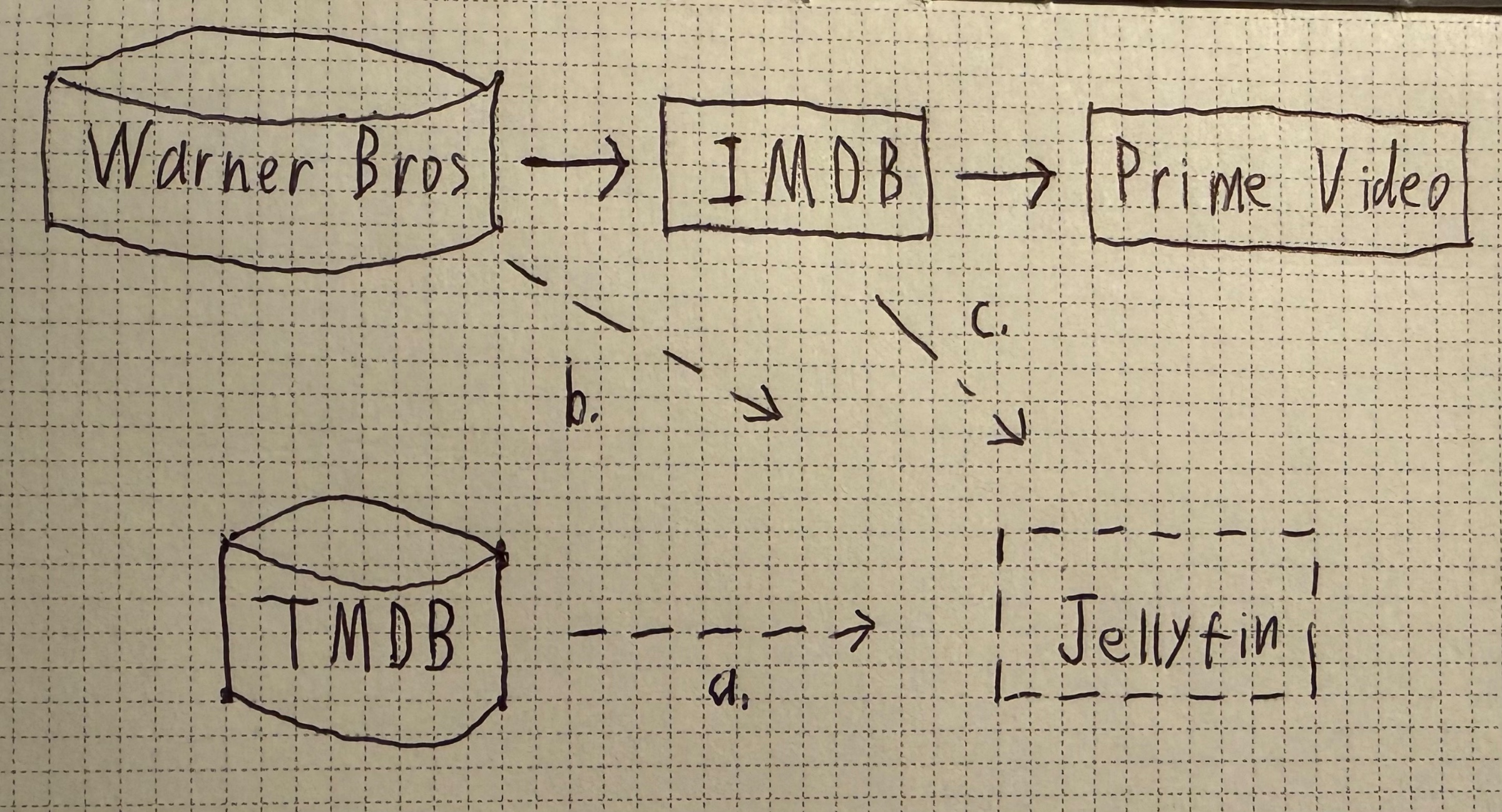
You have 3 choices.
If you pick b, you’re getting it right from the source. Great! But, while I like some of the Warner Bros movies, what do they know about databases? What if their IT team sucks? They seem pretty focused on movies, what if their stuff breaks and now your data is all messed up? (If you can’t tell, this is just the obvious wrong choice, they would probably hang up the phone if you called them to ask for this)
If you pick c, there is now a middleman. That might feel bad. But this is a pretty good middleman. This is actually their whole job. So even if Warner Bros has a fire, they might be a safer bet.
Or you could pick a, which is free. If your app is just for fun, and just for your family and friends, that’s probably the best choice. But if your app is going to the big leagues, you’ll need a good lawyer. Better to just pay IMDB.
These diagrams serve as a great way to build intuition for that code, and once I get familiar with a specific system, my ability to draw these is a good test of that intuition and understanding.
Even the code is not the full story though--that is itself an abstraction. People use "frameworks"--these are popular tools that give you features and tools to build what you want to build. A lot of these frameworks are "free and open source software" (or FOSS, if you’re really into it), which is almost a whole ideology of its own. If you're not familiar with this, I'd say an easy way to understand the philosophy of FOSS is the whole world sharing tools for free. It is ubiquitous in the software industry--it means that people don't need to reinvent the wheel, they can just grab the tool that other people already use and trust, and use that.
They still break sometimes. But the wonderful thing about them is when they do break, you can fix them! Not just for yourself, or your company, but for everyone who uses them. I think FOSS is inherently pro-social.
(If any FOSS mercenaries read this--I’m sure there are all sorts of internal politics I’m oversimplifying here)
Because shared tools like this are often so trustworthy, I think it’s a bit of a sign of experience and tenure when you understand their inner workings--if you’re a true beginner, you’re probably not going to use these in a way that would expose the cracks. So knowledge of the inner workings of these frameworks is hard to fake.
The concept of having fake knowledge is something Plato writes about in Phaedrus, which I actually didn’t really read yet. But I do want to finally finish this blog post. I don’t want to pretend I read Plato. I learned about this via a summary from an AI coding agent. I think this is a very layered image, and if it’s not clear already, I’m not proud of nor do I endorse this kind of usage:
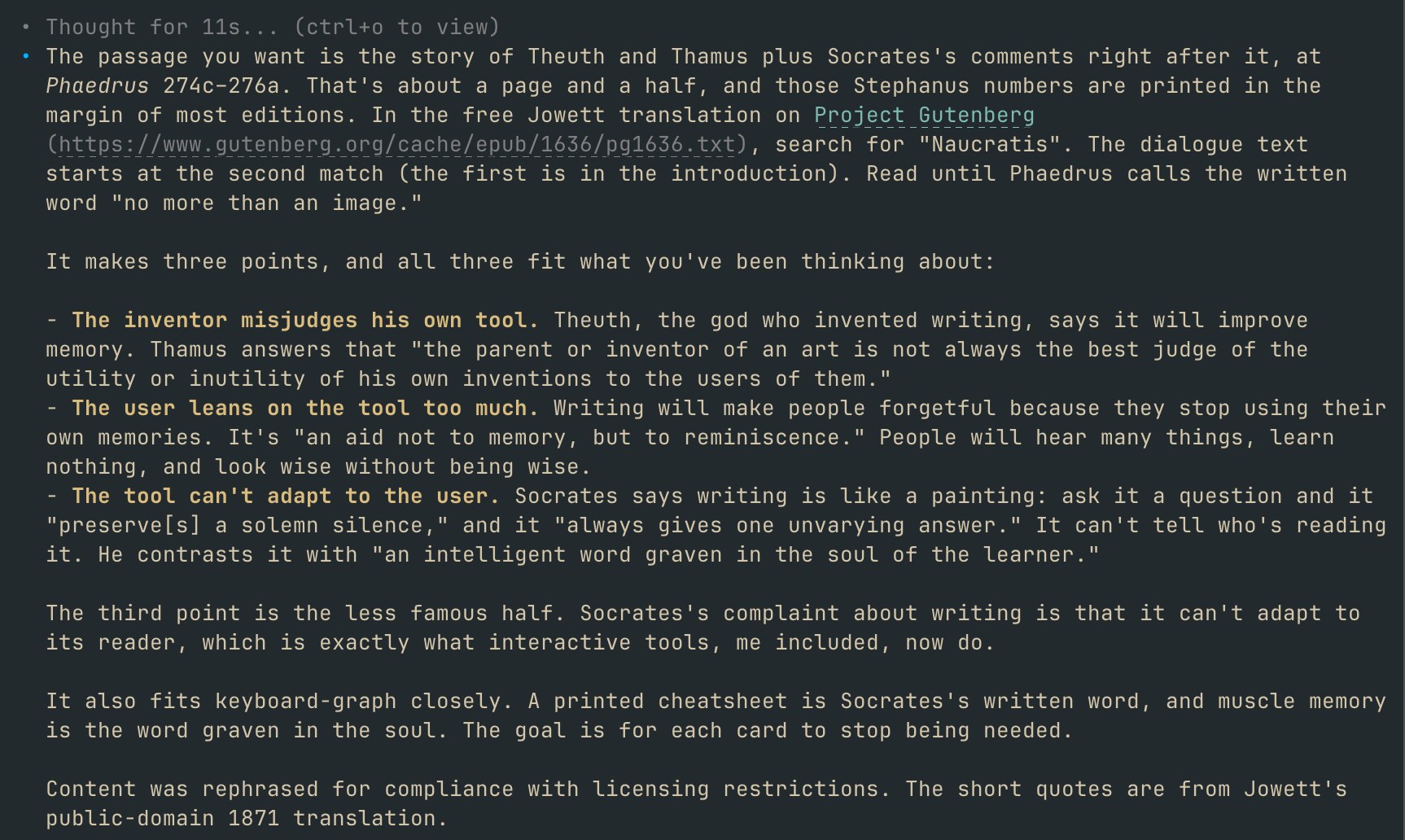
This is a screenshot of a conversation with Claude; this is what that looks like, if you’re unfamiliar. If you want to look closely at this (not sure you should) you can see the mention of "keyboard-graph" there--that's a little custom tool I was building for myself. I wanted it to teach me good keyboard shortcuts, so I can stop using my mouse so much and just be one of those cool hacker guys who only uses the keyboard.
But--some of those shortcuts are just genuinely uncomfortable, like they hurt my hands to press. So I think, to an extent, I do need to make my own keyboard shortcuts. But I don't want to be lazy and always make my own--I want to learn the existing, canonical ones too! For a couple reasons--one, I don't want to just turn off my brain, if I need to learn something I can learn it, I don't need to dictate what every button should do. But two--I don't want to be dependent on my personal setup more than I have to be. Part of being a cool hacker guy who just uses the keyboard is that you can do that on any keyboard, on anyone's computer. The tool is the extension of me--so I will always be dependent on my tools, and they do enable me to do more, but that's a relationship I want to cultivate and nurture.
Your car being dependent on its wheels is not a weakness, nor is a webpage being dependent on your browser to render it. And in fact, I think I should sharpen this--some of these are not "dependencies"--I'd argue the term "relationship" is a better fit.
Eight Sleep is a company that makes smart mattresses that adapt the temperature and other things to you as you sleep. Is that healthy? Is that a dependency? I had thought yes initially. But then a colleague of mine suggested it isn't actually. There's way, way bigger dependencies. An adaptive mattress is perfectly fine. I think everyone has a relationship with their mattress. A lot of other mammals famously build dens to hibernate. (Though that is a also a biological and evolutionary tradeoff--perhaps there is a Bullfrog somewhere writing their own blog post about how strange it is that mammals are dependent on sleep)
I’ll get back to Eight Sleep in a second, but there is a little more background context you might need: AWS, which stands for “Amazon Web Services”, is the biggest provider of cloud computing services. The “cloud” could be thought of as just being someone else’s computer. Amazon make most of their money from this nowadays. They have a lot of computers, and they are very good at running them, so when a company needs a computer to run something 24/7, it can sometimes be a good idea to use AWS. It’s actually very often a good idea. But you should be mindful of how you make that choice.
When AWS went down in October 2025, Eight Sleep mattresses completely broke. They had no offline mode, so they got stuck at whatever setting they were on: some sat at 110°F, others were stuck at an incline, and people couldn't fix it until AWS came back up. (The Verge, Ars Technica).
That was actually multiple dependencies that should have never existed. The fact that the mattress needed an internet connection was already just accepting risk for no reason whatsoever.
Maybe they wanted to collect data on their users! Maybe that’s why it needed an Internet connection--maybe they wanted to make sure people couldn’t opt out of that. Regardless of your ethical stance though, this was still just poor engineering. They could have engineered this system better for evil if that was their real intention, and I doubt it was.
I will now return my focus to dependency on tools. Phaedrus is about this--as is "Tools for Conviviality" by Ivan Illich. I’ve been skimming around that one. He imagines
a society, in which modern technologies serve politically interrelated individuals rather than managers
One thing I inspired recently that I'm proud of is,my little sister's art portfolio studio. I didn't make her art portfolio. And I don't feel honest saying that I made the studio either, since that was Claude. And maybe I didn't even inspire it--I think Greta herself, as well as many other people I talk to who are concerned about AI--are the real seed of this idea. But I did facilitate it, and I'm proud of my role either way.
The initial design concern was: Greta would love a portfolio website, but both of us feel a little weird about using AI for that in the way I've been using AI for other things. Why? What about that feels wrong?
There's a few reasons which are pretty obvious. You just ought not use AI for an art portfolio, I don't think. Everyone makes websites with AI now! How are you being creative if you're just using the color choices, design patterns, visual language, that Opus 5.5 suggests. (For readers who don’t care about AI, Opus 5.5 is a new version of Claude that is very very smart, a bit of a paradigm shift, and is infamous for its "great taste" and design ability.) And Opus 5.5 is going to suggest everyone the same default “tasteful” choices. So even if you have no ethical or moral qualms, for a creative, this just doesn't work.
So instead of just building the site for her, Claude built a tool-- a custom Studio (probably not that custom, I bet Opus 5.5 is making all sorts of people similar Studios) that lets her control and write the HTML and CSS directly. (HTML and CSS are the basic building blocks of webpages. You can get very fancy with just those two--JavaScript is probably the third thing you'd want to learn for making beautiful webpages, but it's not needed--it's not on this website or hers, yet. And using anything fancier than HTML or CSS, you guessed it, would introduce an unnecessary dependency! Greta doesn't want to be managing node packages yet, I don't think). She hasn’t seriously written code before. So it was built with that context in mind.
I talked to Claude about Phaedrus and these ideas to cast the vision for this studio. I think it's cool that that worked. I wonder about my "relationship", or perhaps dependency, with Claude.
One thing I will say is that there's a lot of trust, and using Claude as much as I have has given me a good understanding and intuition of what to trust it with. My prompts are often giving Claude specific details about the things I know need to be a certain way, and then ending with "I trust your judgement on the rest--do a great job." I have no idea if that ending really matters or does anything, I've been meaning to A-B test it at some point, but I also think I'll keep doing this anyways--it's good for me, I think, to be explicit about where I'm handing off control.
Back to Greta’s studio: it has all sorts of tips and tricks to writing HTML and CSS code built in. There's a little curriculum of lessons she can take that actually teach her the HTML and CSS principles directly. I personally haven't even looked at this studio--I trust Claude did a decent job, and if something breaks Greta will tell me.
How this relates to dependency--I don't want to create a dependency on myself here. I don't really want to be responsible for the upkeep of Greta's site. Nor do I want Claude to be, I guess, since that's really what would happen. I want to spend my Claude usage on building my own stuff. And Greta doesn't want to be dependent on me or Claude either. But for now, we all kinda are a little dependent. And that's ok! It's wonderful even! She has an older brother who, despite being very busy with work and his own life, can ask Claude to help her. I should be clearc I feel like I deserve very little credit for this. And yet, I’m still proud. It’s just a less selfish pride now. I feel more aware of all the help I got from Claude. And maybe--maybe as Software people, we never should have been so selfishly proud of our work. It was always dependent on others. We all stood on the shoulders of giants. Maybe that selfish pride that I greive was something I never should’ve had at all. Even if I stopped using Claude today, maybe that pride shouldn’t return in that selfish form.
I wonder if other engineers felt this way in the past. Did people really grieve when something as disgusting and useless as Ruby on Rails came out? It seems like maybe they did.
And as long as I am a Software Engineer I will remain somewhat dependent on Claude--it seems like my whole industry will be. But I'm trying to be very mindful of how, and why, and how to keep that dependency from being stifling to growth.
Back to Greta’s studio again. This specific dependency cluster, between me, Greta, and Claude, already has a pathway out of it baked in. This idea, at least, I will claim full credit for. The implementation of it belongs to Claude, and the actual execution of this plan rests on Greta. The first section of lessons is all HTML and CSS. But the second section is all about moving off the studio--how to download VSCode (for my non-technical readers, VSCode is the most popular, free code editor in the world. It's made by Microsoft), how to use VSCode like she was using the studio, and how to make her changes in VSCode actually get to her website. If she finishes this module of lessons, she won't even need my studio at all anymore.
The third, and final module, is about Cloudflare. I bought gretabordjadze.com on Cloudflare for like $11. Cloudflare is the platform that nearly everyone uses for things like this. If you read that last sentence and thought that sounds concerning, I agree.
So for now I own gretabordjadze.com She did pay me $15 and said keep the change, so I guess I've made $4 on this whole operation, but I still own Greta's name as a website. That doesn't feel right. And there's a little bit of infrastructure in my Cloudflare account that runs her website too.
So the third module of lessons on her studio walks her through making a free Cloudflare account, and setting up the infrastructure for her page on her own. Once she's done that, the only step left is to transfer ownership of gretabordjadze.com over to her account--her studio has a lesson for that too. And that's the final lesson, because once she does that, the studio itself will cease to exist.
Earlier, I wrote about data dependency graphs. And I talked about how those don't tell you the full story--you have to look at the actual code. I think the reason I wrote about that is because it reinforces the concept of "trust" in this conversation. You can't just keep checking everything forever. If your junior developer shows you a convincing diagram, should you still check their code? Yeah. If their code looks good, should you check the language and environment that code runs in? Probably. If those look ok too, should you start to doubt the actual hardware? Probably not. I don’t think that’s your job.
My point is--there comes a point where you have to trust. You are dependent, whether you like it or not, on so many tools, so many people, so many pieces of software. To pretend otherwise is to engage in a fantasy.
(maybe I should dump this whole post into my next Pull Request description, just begging and pleading for someone to trust my code and click “approve”)